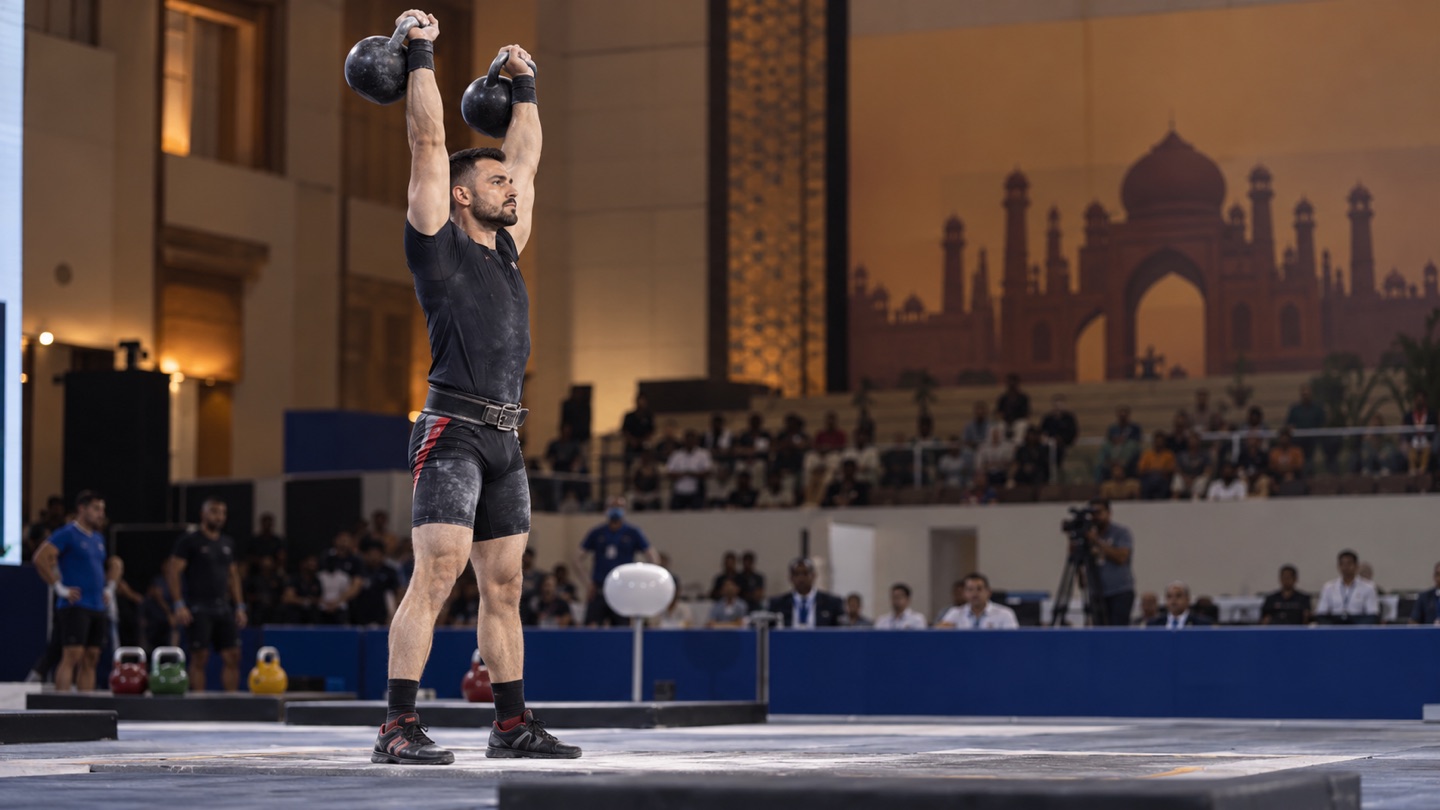
The world kettlebell championships held in New Delhi from 4–9 October ended with a seventh world title for Chechen athlete Movsar Suleymanov. Competing in the 78 kg class, he completed 145 repetitions with two 32 kg kettlebells in the ten-minute classic jerk. The Russian Kettlebell Sport Federation's official summary confirms Russia's team victory, while the regional sports report records Suleymanov's individual result.
At a glance
- Suleymanov competed in the 78 kg class with two 32 kg kettlebells.
- He recorded 145 valid lifts in a ten-minute set.
- The result delivered his seventh world championship gold.
What do 145 lifts mean?
In the classic jerk, Suleymanov drives two kettlebells from the rack position at the chest to a stable overhead lockout accepted by the judges. Two 32 kg implements mean controlling a combined load of 64 kg on every repetition. A continuous ten-minute set demands rhythm, breathing, grip economy and technical consistency as much as strength.
The championship team table
According to the federation's 12 October summary, Russia finished first in the overall team standings, followed by India and Mongolia. The Russian team won 36 gold and 27 silver medals in the senior world championships, and 35 gold, 21 silver and one bronze at junior level. These are full team totals; Suleymanov's gold forms part of the senior result.
A seventh world title
The regional sports report records this medal as Suleymanov's seventh world championship gold. The national federation's team list, published in July, also places him in the 78 kg classic jerk squad. The official pre-event roster and the reported individual result therefore align on both discipline and weight class.
Plan your visit
- Championship
- World Kettlebell Championship, New Delhi
- Weight class
- 78 kg
- Discipline
- Classic jerk with two kettlebells
- Result
- 2 × 32 kg · 10 minutes · 145 lifts
Cinema etiquette
In kettlebell sport, the judges count only repetitions fixed with correct technique, not every attempted lift. Comparing a competition score with an ordinary gym repetition count is therefore misleading.